Opals have a reputation problem. Ask around and someone will tell you they are fragile, that they crack in cold weather, that they belong in a jewellery box rather than on a hand. There is a grain of truth buried in there — opal sits around 5.5 to 6.5 on the Mohs scale, softer than quartz, and it holds water inside its structure — but the conclusion is wrong. Plenty of people wear an opal ring every single day, for years, without drama. The difference between a ring that survives real life and one that ends up in a drawer is almost never luck. It is the stone you pick, the way it is held in the metal, and whether the ring actually fits.
Start With the Stone, Not the Colour
Before you fall for a flash of green in a shop window, decide what kind of opal you are buying. This matters more for daily wear than the pattern or the brightness.
Solid, doublet, or triplet
A solid opal is a single piece of natural opal, cut and polished. It is the most straightforward choice, and if the surface ever picks up a small scratch or scuff, a jeweller can usually repolish it and bring the fire back.
A doublet is a thin slice of opal glued to a dark backing. A triplet adds a clear cap of quartz or glass on top. The cap on a triplet does protect the opal surface from scratches, which sounds ideal, but the trade-off is the glue lines. Water, heat, and repeated cleaning can eventually work at those layers, and a lifted edge is not something you can repair at home. If you want a triplet, buy one from a maker who sets it in a closed-back or well-sealed design and treat it gently.
Where the opal comes from
Australian opals are generally stable and non-hydrophane, meaning they do not soak up water. Many Ethiopian opals are hydrophane: they absorb moisture, can turn temporarily translucent, and are more sensitive to fast changes in humidity. That is not a reason to avoid them, but it does mean an Ethiopian opal is a better fit for someone who takes their ring off before washing up. For a ring that will see dishes, gym sessions, and rainy commutes, a solid Australian stone is the more forgiving starting point.
One more detail: wear shows up differently on different stones. Scuffs and fine scratches tend to be more visible on clear crystal opals than on milky white ones, simply because you can see through them. A slightly milky stone with a strong pattern can be a quietly practical choice for a first everyday ring.
The Setting Does Most of the Work
If you remember one thing from this guide, make it this: the setting protects the stone far more than the stone protects itself. An opal's vulnerable point is its edge, called the girdle, where the dome meets the side. Catch that edge on a door handle and you get a chip. Cover it in metal and the risk drops sharply.
A full bezel — a continuous rim of metal wrapped around the stone — is the most protective option and the one most jewellers recommend for everyday wear. A low dome inside that bezel is even better. Tall cabochons look dramatic but they catch on knitwear, seatbelts, and handbag straps, and every catch is a small lever working against the setting.
Prong settings are lighter and show more of the stone, and they can work for daily wear if they are well made. Look for rounded prongs that sit snugly against the stone rather than tall claws, and check that the prongs rise just above the dome instead of hooking over it. A few things to inspect before you commit:
- Run a fingertip around the setting. Any sharp edge or gap will catch on clothing, and eventually on something less forgiving.
- Turn the ring over. An open back lets dirt and moisture reach the stone; a closed or partially closed back is kinder to opals.
- Check the height. If the stone sits higher than the width of the band, ask yourself whether you will genuinely wear it to the supermarket.
- Look at the shoulders — the metal either side of the stone. Raised shoulders act as bumpers when your hand meets a table edge.
Metal and Band: The Frame Around the Stone
Fourteen-karat gold, eighteen-karat gold, and platinum are all sensible for a ring worn often. Eighteen-karat gold is softer and shows scratches sooner than fourteen-karat, which is one reason many daily-wear designs use fourteen. Sterling silver is perfectly respectable and considerably cheaper, but it is softer still and will wear thin over many years, especially on the underside of the band. White gold needs rhodium re-plating periodically to keep its colour — worth knowing before you buy, not after.
Band thickness is the quiet hero here. A shank under about 1.8 mm thick can bend if you grip something heavy or catch it on a drawer. Something in the 2 mm range, with a comfort-fit interior, feels good and holds its shape. If the design has a thin band and a large stone, the ring will want to spin, and a spinning ring is a ring that gets knocked.
Getting the Fit Right
Opal rings should sit snug enough not to rotate but loose enough to slide over the knuckle without a fight. Two practical points are often missed.
First, wide bands need a larger size than narrow ones, because more metal contacts more of your finger. If you are choosing between a 2 mm band and a 5 mm band, expect roughly a half size difference for the same comfort. Second, measure at the end of the day, at room temperature, when your fingers are at their normal size. Fingers swell in heat, after salty food, during travel, and through pregnancy. A ring bought on a cold morning after a long walk may end up tight by evening.
If your knuckle is noticeably wider than the base of your finger, mention it. A jeweller can suggest a slightly tapered band, small sizing beads inside the shank, or a design that opens at the bottom. And ask about sizing limits before you buy: a ring with a full bezel and detailed shoulders cannot always be resized much, and repeated resizing stresses the setting.
Everyday Habits That Keep It Looking New
Most opal damage is not mysterious. It comes from chemicals, knocks, and temperature swings, and all three are easy to limit.
Take the ring off for cleaning products, chlorine, hair dye, perfume, and hand cream — not because opal is delicate in some abstract sense, but because household chemicals and repeated wet-dry cycles are hard on both the stone and the setting. Skip the ultrasonic and steam cleaners unless your jeweller has specifically confirmed they are safe for your piece; they are risky for doublets, triplets, and many treated stones. Warm water, a drop of mild soap, a soft brush, and a gentle pat dry will do the job.
Store it in its own soft pouch rather than loose in a box with harder stones, and have the setting checked once a year. A prong that has loosened is cheap to tighten and expensive to ignore.
A Practical Checklist Before You Buy
Take this with you, whether you are shopping online or in person:
- Confirm the stone type in writing — solid, doublet, or triplet — and where it originated.
- Choose a bezel or well-made low prong setting with covered or protected edges.
- Check the band is at least around 2 mm thick and feels solid, not springy.
- Try it on at the end of the day and make a fist; it should not press or twist.
- Ask about resizing limits and the return or exchange policy before you pay.
- Ask what cleaning method the maker recommends for that specific stone.
An opal ring does not have to be a special-occasion piece. Pick a solid stone, wrap it in enough metal, keep the profile low, and get the size right, and you will have something you can wear to work on a Monday without thinking twice. That is the whole trick.
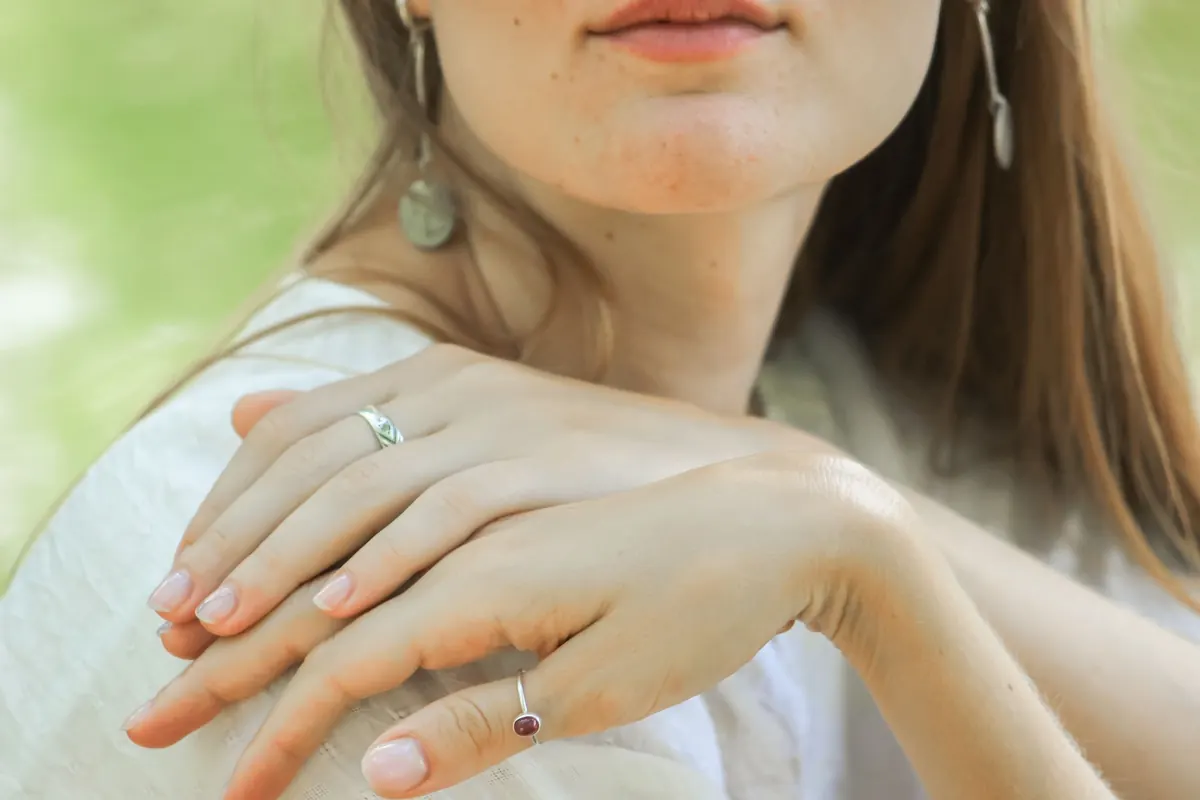
Photo: Natalia Sevruk / Pexels