A ring that fits properly stops being an object on your hand and becomes part of it. That matters more than usual with opal. The stone is soft — softer than quartz, far softer than diamond — and a ring that swivels or slides puts it in the path of door handles, desk edges and shopping trolleys all day long. A ring that pinches brings its own problems: you tug at it, your finger swells, and eventually the band gets forced out of shape.
You can get a reliable measurement at home in about ten minutes, with a ruler, a strip of paper and a ring you already wear. Below is how to measure, how to read the number you get, and how to adjust the result for a stone that deserves a bit of care.
Before you measure: three things that change the number
Ring size is not a fixed property of your finger. It shifts during the day, with the temperature and with how much water you've drunk. Measure under ordinary conditions and you will be closer than someone who measures straight after a long walk in July.
- Temperature. Cold hands shrink, warm hands swell. Measure at room temperature — not just in from the cold, not straight out of a hot shower.
- Time of day. Fingers tend to be smallest in the morning and slightly larger by evening. If you suspect you sit between two sizes, measure in the late afternoon.
- Which hand. Your dominant hand is often a little larger. Measure the exact finger on the exact hand the ring is for, and don't assume the other hand matches.
Then look at your knuckle. If it is noticeably wider than the base of your finger, measure both points and choose a size that clears the knuckle comfortably. The ring will sit a little loose at the base, which is normal and much better than a band you have to wrestle off.
Method one: measure a ring you already own
This is the most accurate route at home, because it takes your finger out of the equation. You need a ring that fits the right finger well, a ruler marked in millimetres, and a flat surface.
- Lay the ring flat with the band facing up.
- Measure the inside diameter — the clear opening across the middle of the band, from inner edge to inner edge. Do not include the metal itself.
- Note the figure in millimetres. Take the widest and narrowest points and average them, which compensates for a band that isn't perfectly round.
- Repeat the whole measurement twice. If the numbers agree, match your millimetre figure to the size chart of the jeweller you're buying from.
One warning: if the ring you are measuring has a very different band width from the one you plan to buy, the result will be off. A 2 mm band and a 6 mm band of the same stated size do not feel the same on the finger. More on that below.
Method two: measure your finger with paper
No suitable ring? A narrow strip of paper works well. String is a common substitute, but it stretches and flattens as you wrap it, which quietly inflates your measurement.
- Cut a strip of paper roughly 1 cm wide and 10 cm long, with straight edges.
- Wrap it around the base of the finger, just below the knuckle. Snug, but able to slide over the knuckle with a little effort.
- Mark where the paper overlaps, on the edge that meets the finger.
- Lay the strip flat and measure from the end to the mark. That is your inner circumference.
- Measure three times. If the results differ by more than a millimetre, the strip twisted or you pulled it too tight — start again.
- Match the circumference to the seller's chart, or divide it by 3.14 to get the diameter and compare that instead.
Take both measurements if you can. When the ring method and the paper method agree, you can order with confidence; when they don't, the ring method usually wins.
Reading the numbers: sizes are not universal
Ring sizing comes in several systems that do not line up neatly. US sizes are numbers, often with half and quarter steps. UK and Australian sizes are letters. Most European charts simply use the inner circumference in millimetres. A US 6, a UK L and a European 52 all sit in roughly the same place — roughly, not exactly.
That is why the safest move is to buy from a jeweller who publishes a chart listing both diameter and circumference, and to match your own millimetre measurement against it. If a seller only quotes US sizes, ask for the inner diameter in millimetres. Any jeweller used to working with opal will answer that question without fuss.
And keep band width in mind. A wide band covers more of your finger and needs to be around half a size larger to feel the same as a slim one. If you are choosing between a 2 mm solitaire band and a 7 mm statement band, do not assume one size fits both.
Fine-tuning the fit for an opal ring
Setting height and band width
A high cabochon in a tall setting catches on knitwear, hair and jacket linings if it can rotate freely. For those designs, a slightly closer fit is usually the kinder choice. A low-profile bezel sits closer to the hand and can afford a little more room, which many people find more comfortable in warm weather.
Resizing is possible, but don't plan on it
Many opal rings can be resized, though some settings make it awkward: full bezels, patterned shoulders and bands that run a design all the way around all limit how far the metal can move. Opal is also sensitive to heat, so many jewellers prefer to remove the stone before soldering or to work with extra care. Getting the size right the first time is simpler, cheaper and safer for the stone.
Normal swelling is not a sizing error
Fingers change with the seasons and over the years. A ring that feels snug in a heatwave can feel loose in February. If you are genuinely between two sizes, choose the larger one when the band is wide or your knuckle is prominent, and the smaller one when the stone sits high and you want to limit movement. Either way, leave enough room that the ring slides over the knuckle without a fight.
A final check before you order
Measure once in the morning and once in the evening, and order from the figure they support. Confirm the seller's chart lists millimetres rather than a single letter or number, and check whether their sizes assume a standard band width. Read the exchange policy before you pay: a ring that arrives a half size out is a nuisance, and a ring with an opal in it should not be forced on and off while you decide.
If the ring is a gift and you cannot measure the right finger, borrow a ring they wear on that finger and measure its inner diameter. It is the least intrusive way to get it right, and it works.
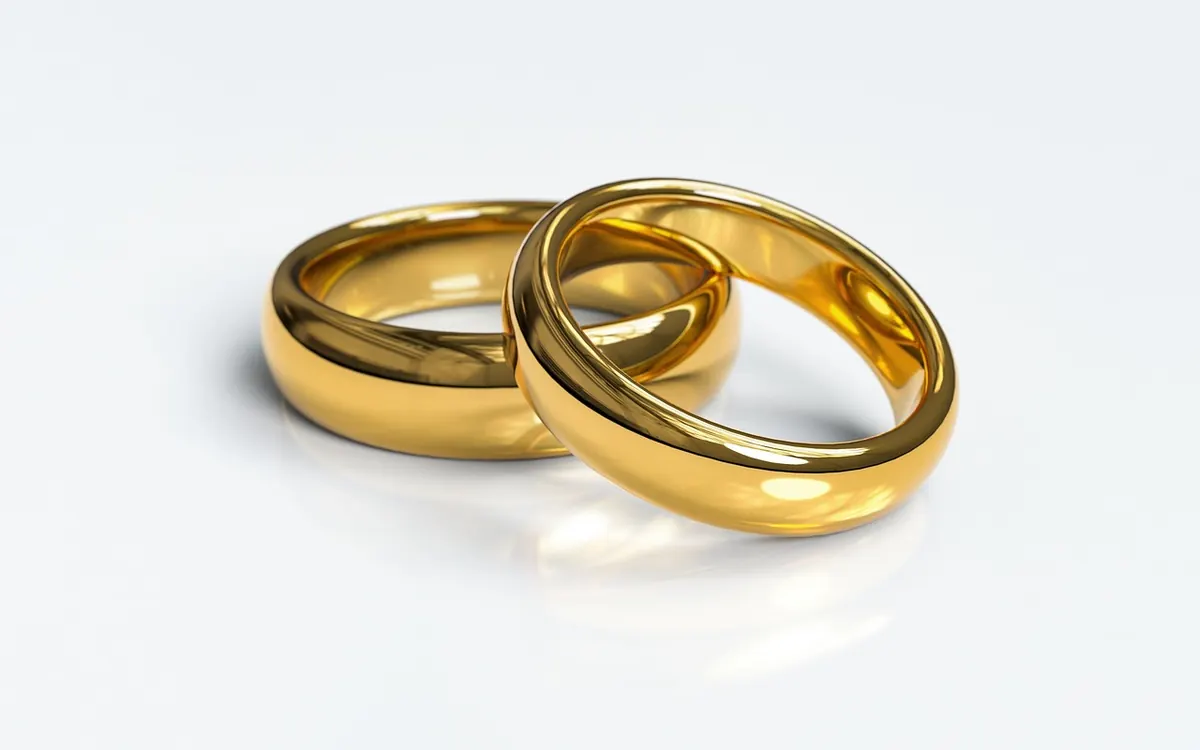
Photo: qimono / Pixabay